Mainichi Hanafuda: lightning

With every other card that I drew, I looked at a few different hanafuda decks for reference, consulted photographs or tattoos, and tried to create it with something resembling a unique style. Most of them are very stylized, but also very representative of the subject. The sheer abstractness of this design was so wonderful that I decided to drop all that and go for straight emulation for once.

 Here's the animal card for the willow/rain suit. Readers who know me very well may have seen this swallow somewhere before, since I have two of them tattooed on my chest! I got to cheat and use it again in my hanafuda deck, although it's not really cheating since I did the original bird design myself.
 The subject of the "rain man" willow card is
  There's a lot going on in the willow suit, so I'm going to back off and do one card per day again until we're through it. For starters, there's only one 'junk' card in this suit, and it's a weird one. Most of the cards portray a willow tree, but it's alternately known as the "rain" suit. Finally, it's November in Japanese hanafuda, but December in Korea.
 Behold the mighty phoenix, or, depending on which hanafuda page you read, possibly a chicken? Actually, it's not supposed to be either. A definitive source identifies this animal as the
  It all depends on what game you're playing, but in the rules of Japanese Koi Koi, the paulownia suit is the only one with three junk cards. However, the third one is decorated with a colored ground and (usually) the name of the manufacturer.
 I didn't know what a wisteria looks like, but at least I had heard of it before. Paulowia? Yes, it's a real thing! Apparently it is a type of tree, and the flowers look a little something like the cards on your left, which are the two 'junks' from the suit.
 A blank red ribbon and a cuckoo are the subjects of today's cards.
 I got all fancy with the pine and peonies, but I went back to basics for April's wisteria suit. Actually looks a bit dull in comparison, doesn't it? Since it isn't very exciting, here's half the suit for you to enjoy!
 I saved the best peony card for last: here is the suit's animal. Every hanafuda site I have found simply identifies it as 'butterfly.' Since I made fancy peonies, I figured I'd might as well pick a fancy butterfly to go along with them, so I used a swallowtail for reference. Fly, little swallowtail, fly! Be wary of the ominous red clouds above you.
 This card introduces another ribbon variation: the blue (in Korean decks) or purple ribbon (in Japanese decks). This is the third and final style of ribbon in hanafuda, including the blank red ribbons and 'poem' ribbons. Two other purple ribbons are yet to come.
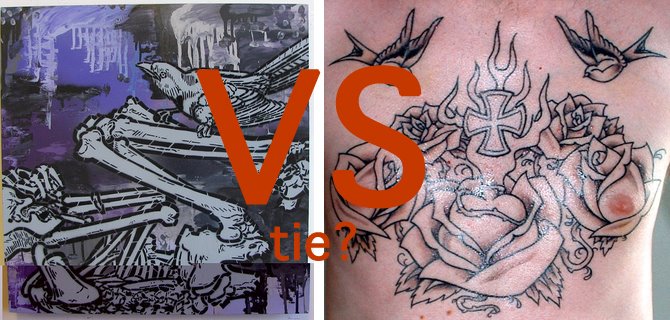
 With my peony art, I made another break from contemporary drab hanafuda designs. I wasn't satisfied with what I could find in source material, and real-life peonies are complicated flowers, so I wondered: what other art form specializes in simplifying images? But of course, tattoos!
 Say hello to the first card from June's peony suit! If there's such a thing as a 'standard' suit in hanafuda, this is as close as it comes: we've got two junks, one ribbon, and one animal card (with an actual animal drawn on it this time). If you've been paying attention, you might be able to figure out on your own that this is junk #1.
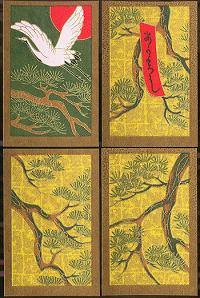
 The pine suit contains the second 'poem' style red ribbon. This card rounds out the suit, and I'm so pleased with how it turned out, that I've decided to experiment more with the upcoming months.
 I mentioned that my pine cards are very unlike those in hanafuda decks you can buy at 7-11s all over Japan, but this style is not without precedent. In
 There's a wide difference here between my original design (right) and the final card with my snowy pine branches. This card has an animal on it, but it's not an "animal" card; it's a "bright."
 I made a huge break with convention on this suit, which represents the month of January. On the right, my first attempt, a pine card in the modern 'stumpy' style. It looks... okay... but nothing like the Japanese pine that I love to see and draw. So I went oldschool on it and came up with the design to your left, featuring snow-covered branches inspired by a Hokusai woodblock print.
 Here's another red banner without writing. Design-wise, I aim for simplicity with the junk cards and try to make them fairly similar. With the point cards like this one, I am starting to throw in some extra elements and mix it up a bit. I decided to include a couple of iris buds on this card to distinguish it from the others in the suit.
 Here we have the other half of the junk irises. Did you know that in Japan, irises are regarded as a symbol of success? I learned this from the description under a nice print of irises in my Hokusai book. In that same print, a grasshopper is walking down the leaf of an iris. Perhaps a grasshopper is the invisible animal in yesterday's card?
 It's weird, but not all the "animal" cards in a hanafuda deck are actually illustrated with pictures of animals! The iris suit serves up the exception to the rule with this card. What we've got here is a dock or plank of some kind over water.
 All the previous suits have been 'flower cards,' of course, but they're not subjects I tend to think of as flowers: plum's a tree, grass is grass, and clover's more of a weed? Today we begin the iris, a suit that's identified clearly by its prominent flowers.
 This clover card holds a banner like
  Like the nightingale for plum, the boar is an animal card in the clover suit. I was unhappy with my source images for boars until I found this
  This is the second "junk" card in July's clover suit.
 Today, we move back one month to the July suit, clover. It's fun to draw branching geometric shapes! Originally, I thought the clover suit was one of the worst in the deck. It looked pretty boring. I dug through lots of photos of wild clover to see how I could embellish on the designs I found online, and finally ended up doing something that looks a lot like normal hanafuda cards anyway.
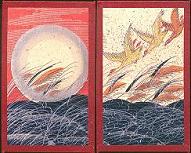
  A flock, or three, geese fly over the hills of pampas grass. Geese were chosen to represent the August suit for Japan, but they would also be appropriate for a Minnesota hanafuda deck, if there was such a thing. Jenna and I spent last weekend in the country. As I was tending the fire, I heard for the first time this summer, some geese discussing a southern vacation. Soon they'll be honkin' all overhead until they've passed through here and arrived at Florida for the winter.
 If the junk plum cards looked somewhat similar, then these pampas grass junks will look almost identical. But, examine them closely and you'll see that the lines are quite different. I hand-illustrated each individual card, even when I could've faked it and it would be purt near impossible to tell. That's just how I roll.
 This is possibly my favorite card in the entire hanafuda deck, and one that's even more striking with a darker grass color. The "junk" cards in the pampas grass suit--like the one I displayed yesterday--are perhaps the least striking in the entire deck. But when the rounded hill of grass is contrasted with the bright full moon, it makes a striking image. This is one of two distinctive point cards in the suit, and a timely one, since August is the month represented here. (The full moon was on August 9th this year.)
 In the first four days of mainichi hanafuda, we looked at February's suit, which is plum. Everybody likes plum blossoms! But what's this thing supposed to be? Compared to the plum, it isn't pretty at all; it's just a hill of pampas grass, or eulalia. On most of the hanafuda decks I found online, this suit didn't even look like grass, it just looked like a big, round, black lump. And because this suit appears as an indistinguishable mound in most decks, Korean players have been known to refer to it as the "poop" suit.
 Most sources I found identified the bird in this suit as a nightingale, although it was called something else in one place I looked. In Japan, the most common birds that I saw around plum trees were actually pigeons. But I used a nightingale for my photo reference on this card, so that's what I've got in my hanafuda deck.
 This is the other junk card from this suit. Notice how it's similar to yesterday's design, but a different pattern. You can also see a "full-on" blossom in this image. Variations on a theme are what make this type of work interesting; the changes in each card must be subtle enough that they can still be recognized as a piece of the whole suit. That's a particular challenge with hanafuda, since they don't use identifying numbers or symbols like a Western deck of playing cards. That's part of what appeals to me about the look of hanafuda. But, it makes hanafuda games a little trickier to learn, since first you have to learn what each of the cards mean!
 A standard Japanese hanafuda deck contains 12 suits of 4 cards each. Most of the suits contain 2 valuable cards that can be used to make high-point combinations, and 2 "junk" cards. Yesterday's red-banner card was special, and today's is one of the two junk cards in the plum suit. I enjoyed illustrating these plum trees, because it was one of the subjects I learned to paint during my Sumi-e class at Kansai Gaidai. Of course, it's a different technique and a much smaller scale, but I think they turned out very attractive all the same.
 I've decided to take on the challenge of illustrating a full deck of Japanese